From MOQs to capsule types, size, quality control, and more – learn the answers to the most common capsule manufacturing questions.
Ben Steuart
December 29, 2025
Launching a capsule-based supplement is exciting. But then you start learning how things get made, it can get overwhelming pretty quickly.
Capsule types, sizes, testing requirements, minimum order quantities, lead times, quality control, moisture sensitivity, excipients (aka, the “other ingredients”), and the list goes on…
Let’s slow things down, ditch the jargon, and walk through the most common questions founders have about capsule manufacturing — all in plain English.
What Minimum Order Quantities Should I Expect?
You can find manufacturers who run as few as 100 bottles, or as many as tens of thousands. Who you work with depends on where you are in your journey and what your specific needs are.
(Startups launching their first product and established brands looking to scale have very different requirements)
In general:
New brands that want to start with as small an investment as possible should look for manufacturers offering private or white label services. They’ll add your label to a stock formulation, work with MOQs between 100 - 200 bottles, and are perfect for companies that want to test the market with low-commitment batches.
Growing brands (or a brand that wants a custom formula) that need 2,000 - 5,000 bottles can work with most mid-tier manufacturers. In contrast to white label services offering stock formulations, these companies can source ingredients and help produce a custom product.
Established or fast-scaling brands anticipating rapid growth should look for a capsule manufacturer who can handle both medium (2,000 - 5,000 bottles) as well as large order quantities (20,000 - 50,000 or more). Initial manufacturers who can only fit your current size can be a bottleneck if your next order needs to be significantly larger. Look for plants with automated capsule-filling equipment and ample production capacity.
Steuart Nutrition offers capsule supplement manufacturing services to growing and established brands that need 5,000 units/bottles or more.
What Does Capsule Supplement Manufacturing Cost?
It’s tough to share anything but a general estimate. Product characteristics, order volumes, capsule size, type, and formulation all impact pricing.
For an accurate estimate, contact a manufacturer or reach out to us for a free consultation.
{{inline-cta}}
Hard vs Softgel Capsules
Hard capsules are made from a separate cap and body that are typically filled with dry ingredients (like powders or pellets).
Softgels are one-piece gelatin capsules filled with liquids or semi-solids.
Key differences:
Hard Capsules: Also known as hard gelatin capsules (HGC) are made of two pieces that lock together, contain powders or granular fills, but can also hold specially formulated oils or be filled with liquid and band sealed. They’re relatively easy to produce and commonly used for a wide range of supplements.
Softgel capsules (SGC): They’re hermetically sealed around liquids or pastes, and while HGCs can contain liquids or oils, softgels are often preferred because they better contain the liquids and are tamper-evident. However, the manufacturing process is more complex and requires more expensive equipment and/or specialized facilities.
Each has its place: hard capsules offer flexibility and easier production in-house, whereas softgels offer a slick way to deliver liquids and oils but typically involve higher complexity and production costs.
Should I Put Liquids and Oils into Hard or Softgel Capsules?
Each method has its nuances, but there are plenty of options to encapsulate liquids depending on your scale and budget.
Softgels are the go-to for liquids and oils. They’re popular for fish oils, vitamin D/A/E, CBD, and others because they keep contents contained with an air-tight seal, have an easy-to-swallow texture, and protect from oxidation to some extent. The primary consideration is that softgels are more expensive, require specialized equipment and expertise, and have longer lead times.
Liquid-filled hard capsules are a viable alternative in some cases. These carry the advantage of less complexity, shorter lead times, cost savings, and can even accommodate high-temperature fills or liquids with small suspended solids that softgels can’t.
Water-based liquids don’t work (they dissolve hard shells), but oils or hydrophobic liquids do. Another creative approach is to avoid liquids altogether by mixing oils with absorbent powders, transforming the formulation into a free-flowing powder.
How Long Does Capsule Supplement Manufacturing Take?
Lead times can vary widely, but in general, capsule products are more efficient to produce than softgels. Production timelines with a capsule contract manufacturer might look like this:
Custom Formula: Expect roughly 8–16 weeks total, from purchase order to finished capsules. This includes ordering all raw ingredients (which can cause delays if any are hard to source), blending, encapsulating, testing, and packaging. First-time productions tend to be on the longer end (3-4 months) because of upfront formulation R&D and stability testing.
Repeat or Simple Formula: Many capsule supplement orders can finish in 4–8 weeks. The encapsulation step itself is quick – automatic machines can fill tens of thousands of capsules per hour. Much of the lead time comes from upstream steps (ingredient procurement, testing) and downstream steps (bottling, labeling, lab testing).
Stock Formulas: If you are using a pre-made formula or a private label product (where the formula and ingredients are already in stock with the manufacturer), turnaround can be as little as 2–4 weeks. Development is finished, so all that’s left is encapsulation and packaging.
Keep in mind these are typical production lead times that assume you’ve already handled product development and regulatory steps. Seasonal demand and manufacturer capacity also matter. For instance, the supplement industry’s Q4 busy season could impact lead time.
Always discuss timelines with your partner, and build in some buffer. Good manufacturers will also inform you if any steps (like getting a label claim verified or specialized testing) might add extra time.
Hard Capsule Sizes and Fill Volumes
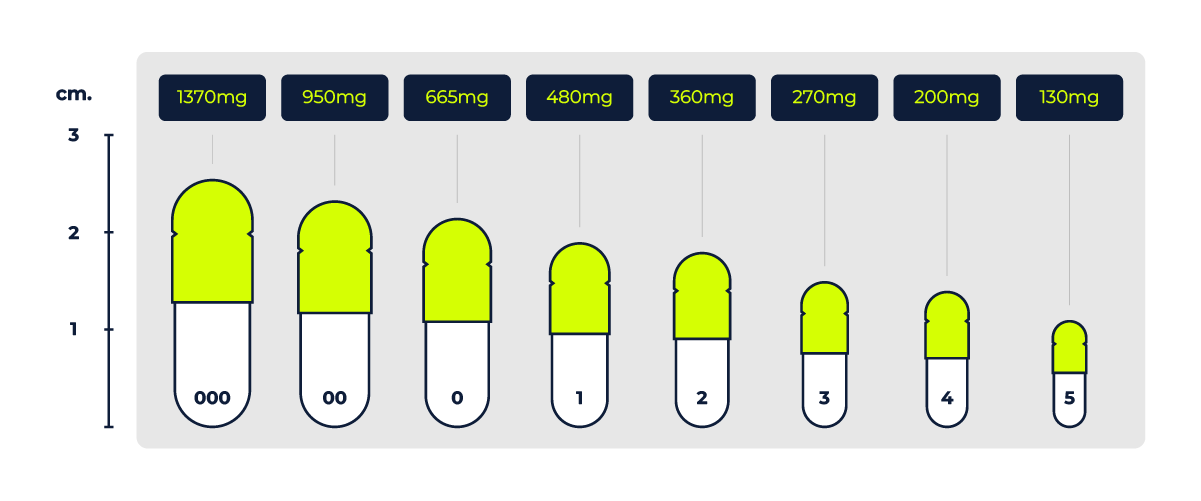
Sizes range from 000 (the largest) down to 5 (the smallest).
Maximum fill weights depend on the density of your formulation, and approximately match the below.
Size 000: Quite large (about 26 mm long) and used for high-dose products or bulky powders.
Size 00: Often called “double-zero,” many dietary supplements use this size if large fill weights are needed.
Size 0: One of the most common sizes for dietary supplements, and are easy to swallow for most adults.
Size 1: Often used if the formula has a lower dose or for products targeting consumers who prefer smaller pills.
Sizes 2, 3, 4, 5: These progressively smaller capsules are used for very potent ingredients, pediatric supplements, or even pet supplements where dose amounts are low.
Most human supplements use sizes 0, 00, or 1 as these balance ample capacity with a swallowable size. When choosing, formulators consider dose and bulk density of the powder. For instance, a fluffy powder might need a larger capsule to fit the same weight compared to a dense mineral salt.
Capsule size charts are a helpful tool to match your formula to the right capsule. Additionally, it’s important to make sure your capsule is compatible with available manufacturing equipment and packaging – very large or very small capsules might need special setups.
Gelatin vs Vegetarian Materials
Capsule shells can be made from either gelatin (an animal-derived product) or plant-derived cellulose.
Here’s how they differ:
Gelatin Capsules: In general, if your consumer has no objections to animal-based ingredients, these capsules are an efficient and reliable choice. They’re popular because they are cost-effective, smooth, and dissolve quickly at body temperature. They’re also available in many sizes and colors, and generally have slightly more flexibility in manufacturing. However, gelatin can also be sensitive to very hot or very humid conditions, causing capsules to stick or deform, while very low humidity can make them brittle.
Vegetarian Capsules: Suitable for vegetarians, vegans, and consumers with faith-based dietary requirements. They’re made from HPMC (hydroxypropyl methylcellulose), or sometimes from polysaccharides like pullulan (fermented tapioca). Modern HPMC capsules perform comparably to gelatin in dissolving and releasing contents, though they can take a bit longer to dissolve in some cases. However, vegetarian capsules tend to cost more to produce. Also, HPMC capsules can be more sensitive to moisture and generally have lower moisture content to begin with, and in very humid storage, may soften unless packaged with drying agents. On the flip side, they are often a bit more stable in high heat, and resist UV light better.
To decide, consider your consumer’s preferences. If you want a “clean” or animal-free label, vegetarian capsules are the way to go. Many brands now offer their supplement in vegetarian capsules to appeal to a broader audience despite the higher cost, as the difference in unit price can be modest when weighed against consumer goodwill.
If those considerations aren’t a priority, gelatin capsules offer a more economical option.
Capsules vs. Tablets vs. Gummies: Which is Better?
Capsules are favored for quick release and fewer additives, tablets for cost and compactness, and gummies for palatability. However, the “best” form depends on your specific product and consumer preferences:
Capsules: Shells mask the powder taste, and usually contain fewer additives than tablets. They dissolve quickly, and since the contents aren’t compressed, they may be more effective for certain nutrient deliveries because more of the active ingredient can be absorbed. However, they may expire or degrade faster than tablets if not stored properly, and very large capsules (like size 00 or 000) can be hard for some people to swallow.
Tablets: Made by compressing ingredients into a solid pill, they’re cost-effective to produce at scale and can often hold a higher dose in a smaller size than capsules. They can be coated or made chewable for taste or delayed release. On the downside, tablets take longer to break down in the digestive tract, and some people find large pills difficult to swallow or get upset stomachs from certain binders or fillers. Another consideration for “clean label” products is that, sometimes, we need to use more excipients (extra ingredients) to make sure they press well.
Gummies: Popular among people who dislike swallowing pills. They are easy and enjoyable to take, often fruit-flavored and chewy – great for children or adults who want a candy-like experience. However, they usually contain sugars or sweeteners or additives and, as such, can’t pack as high a dose of active ingredients. There’s also the risk of extra calories or cavities due to sugar. Additionally, stability can be an issue: gummy ingredients may degrade faster over time, especially for heat-sensitive ingredients, and require careful packaging to prevent sticking or melting.
A brand might choose capsules for a herbal extract product to avoid pressing issues, tablets for a high-dose multi-vitamin (to fit it all in one pill), or gummies for a kid-friendly supplement.
The decision comes down to the target audience and the formulation requirements.
How Does Quality Control Work?
Capsule supplements undergo rigorous quality control (QC) tests to ensure each batch is safe and meets certain specifications. By adhering to pharmacopeial standards and Good Manufacturing Practice (GMP) guidelines, manufacturers make sure each capsule is consistent, effective, and safe for consumers.
Common QC tests include:
Weight Variation & Content Uniformity: Typically, 20 capsules are individually weighed to ensure consistency, and active ingredient content is assayed to confirm uniform dosage.
Disintegration or Dissolution: Testing if capsules break down within a specified time (usually within about 30 minutes for hard capsules) and release their contents properly. This ensures nutrients or actives are available for absorption.
Moisture and Stability: Monitoring the moisture content of capsules (especially important for gelatin shells), and performing stability studies to confirm the product maintains potency through its shelf life.
Microbial and Heavy Metal Testing: Good Manufacturing Practice (GMP) certified manufacturers will provide a Certificate of Analysis for each batch, confirming it passes all required tests, meets safety standards for microbial counts, and is free of contaminants like heavy metals.
Why Are Excipients (“Other Ingredients”) Included?
They make manufacturing possible, preventing machine jams, speeding up output, and ensuring capsules are consistent in dosage and quality.
Even though they don’t provide nutritional value or therapeutic effects themselves, they play several important roles:
Fillers and Diluents: Many capsules need extra material to achieve a suitable volume. For example, if your active ingredient dose is only 100 mg, a size 0 capsule might hold ~500 mg total, so you need an additional ~400 mg of filler to fill the capsule. Common fillers include microcrystalline cellulose (MCC) or rice flour. These ingredients are pharmacologically inert but provide bulk.
Flow Agents or Lubricants: Powders must flow smoothly through machinery. For instance, magnesium stearate is a powder lubricant – coating particles so they don’t stick to each other or the machine, while silicon dioxide (essentially a very fine sand) improves flow properties of the powder blend.
Moisture Control: Dicalcium phosphate, for instance, can absorb excess moisture in a blend, preventing ingredients from caking or degrading. Others, like certain starches, might help a capsule’s contents disperse faster once the shell dissolves.
Uniformity and Processing Aids: Excipients ensure each capsule has the same amount of active ingredient. They achieve a uniform mix so potent actives are evenly distributed. They can also improve a powder’s compressibility or weight consistency, which is crucial for high-speed machines to fill each capsule accurately.
All excipients used in reputable supplements are FDA-approved as GRAS (Generally Recognized as Safe) for consumption, and usually appear in the Other Ingredients list on the supplement label.
Can I Use Natural or Organic Excipients?
With the push for "clean label" products, many brands wonder if they can avoid synthetic-sounding excipients like magnesium stearate or silicon dioxide. Options exist, but expect higher production costs and possibly longer lead times.
Here are the trade-offs to understand:
Production Impact: When creating all-organic blends, machines have to be run more slowly to avoid jamming or weight variation issues. The most common natural fillers are organic rice bran or concentrate, and there are also rice-based flow agents that can replace magnesium stearate or silicon dioxide. They allow brands to claim “all natural ingredients,” but absorb moisture, can become sticky, and make the manufacturing process less efficient.
Cost and Lead Time: A high-speed machine might normally run 90,000 capsules per hour, but only 40,000 with organic excipients. Additionally, natural ingredients are often more expensive, and can raise filler costs by as much as 2–3x.
Balancing Choices: If an organic label that says “No synthetic additives” is a core value for your brand, the higher cost can be worthwhile. On the other hand, if cost, scale, and consistency are paramount, using the standard excipients might be more practical. Some brands opt for a middle ground, choosing ingredients that sound familiar (like rice flour), which may be more acceptable to consumers than a chemical name.
Transparency is key. Whichever excipients you use, be clear with your customers why they're there. This helps consumers understand that additives, whether conventional or natural, are there to improve a product’s quality and not as just “fillers” in the negative sense.
Need Help Choosing? Consider Steuart Nutrition.
When the time is right, book a discovery call. We’ll walk you through your capsule choice, packaging needs, costs, send samples, and provide a no-pressure roadmap developed by a capsule manufacturing team that’s been there.
Ben Steuart — CEO & Owner, Steuart Nutrition
Ben Steuart is the co-founder and CEO of Steuart Nutrition, a contract manufacturing and supplement innovation partner for powder, liquid, and stick‑pack supplements. He launched the company in 2019 alongside his wife, Sarah, building on his lifelong roots in the food production industry, where he grew up working in his father's manufacturing business in Mabel, Minnesota.
Throughout his career, Ben has developed deep expertise in supplement manufacturing and business operations. At Steuart, he leads with a commitment to lean operations, fostering long-term partnerships, and delivering flexible, transparent service—prioritizing the client’s vision as much as his own. His leadership guided the business’s rapid expansion from a single facility to multiple locations, enabling agile responses to market needs—from producing hand sanitizer during the COVID‑19 pandemic to scaling CBD and nutrition supplement lines.